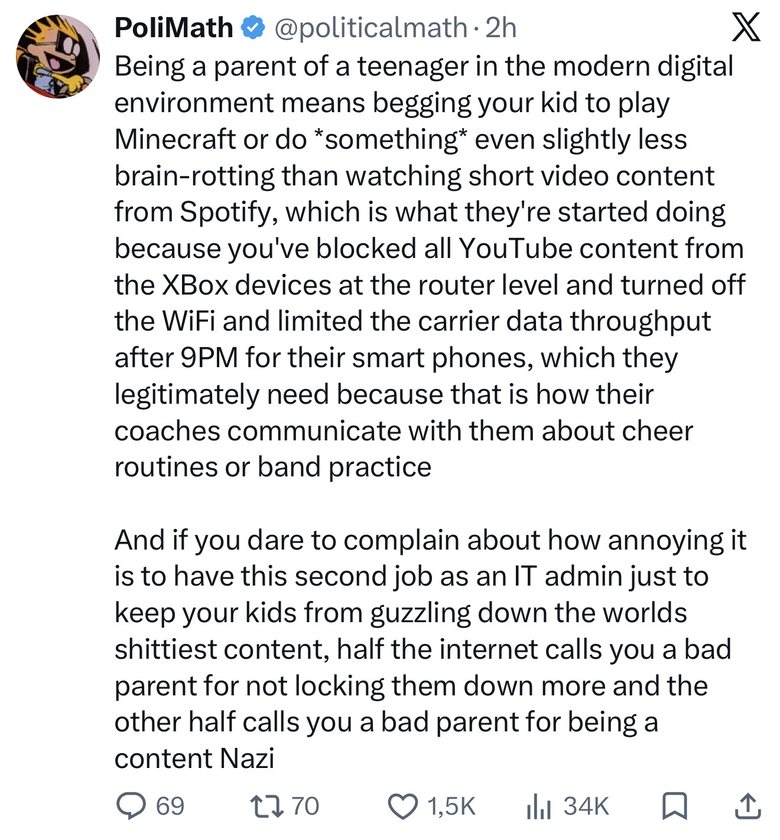
A parent on X, 10 November 2026
He blocked YouTube at the router and his kids found short videos on Spotify. Take one supply away and the wanting moves to the next.
This is the science, checked without mercy.
Every finding in Cor, the evidence record behind this site, is traced to the study itself and graded by how hard it was tested. Each new or changed grade names the strongest study behind it and that study's main weakness. A grade never goes up because it would help a page. A finding that failed to replicate is marked down, however widely it is cited. Cor keeps 139 records of evidence against itself. It publishes the 23 strongest attacks on its own work and names six results that would kill it. It's, in a word, really good science.
What really is:
What it really is
People-watching.
Humans are built to watch other humans, and the feed is an endless supply of people who will never know you.
For 300,000 years, the people you watched lived in your camp.
Not being able to stop watching is completely normal.
Sources: EEA-SOC-03; EEA-INFO-02. Time scale: Hublin et al. 2017; Richter et al. 2017.Gold rings: the alarm is on
See the whole line: 11,100 generations of your ancestors, then you.
Humans are built to keep track of the people around them.
In forager camps, talk about who did what was the main flow of information. It is how people learned the rules and kept track of each other.
tested many timesEEA-INFO-02 Gossip and story as the main information flowtested many timesE373 Boehmtested onceE720 Wiessner 2014, one population
The people you would watch used to live around you. Now you are often alone.
People lived in camps of a few dozen, where everyone could see what everyone else was doing.
tested many timesEEA-SOC-03 Camp sizeargued, not yet testedEEA-SOC-09 Everyone visible to everyone
Not in Cor yet: how much of today's scrolling happens alone.
A feed fills the gap with strangers, for the effort of one swipe.
In animals, an exaggerated copy of a natural signal can pull harder than the real thing. And for most of history, what you heard came from people you knew.
argued, not yet testedE113 Tinbergenseen in animalsE424 Tinbergenargued, not yet testedEEA-INFO-01 Information from people you know
Nothing comes of it, so the wanting never switches off.
So you swipe again.
Wanting and satisfaction run on separate systems. A cue can keep the wanting going without ever delivering anything.
tested many timesE451 BerridgeM2 Pursuit and exploration
Cor puts endless scrolling on the second-lowest rung for this system, and flags that ranking as open to challenge.
There is no last video, because your hours are what is sold.
Markets can turn an unmet need into a business. Cor's records on this are slot machines, designed for time on the machine.
tested many timesE448 Schülltested onceE447 Schüll
Not in Cor yet: any study of video feeds themselves.
A parent on X, 10 November 2026
He blocked YouTube at the router and his kids found short videos on Spotify. Take one supply away and the wanting moves to the next.
watching out of pure addiction and not even deriving pleasure from it
Teo Almaguer, student, in The Daily Tar Heel, 14 November 2024
Wanting without enjoying, in his own words. Those are two separate systems, and the feed only feeds the first.
It was at least five hours a day. It was mad
Zach Garvey, 17, in The Irish Times, 16 September 2023
He calls his own hours mad. The wanting runs without asking him.
I spend a few hours each day watching such videos. As a retired factory worker, I have plenty of spare time, so why not?
Li Xuejun, 71, in Sixth Tone, 26 October 2020
This is no teenage problem. An empty day gets filled the same way at 71.
An addiction
No drug needed. Slot machines set off the same wanting loop.
Brain rot
The content is other humans, which is what brains track. A feed has none you know.
Weak willpower
The pull comes from one of the oldest systems in the brain. A cue is enough to keep it going.
Bad parenting
In forager camps many carers shared the watching, older children among them. Now it falls on one or two parents.
Oldest. Brainstem and hypothalamus, about 500 million years old
Wanting, energy, sex. Cannot learn that a screen is a screen.
Wanting with nothing to finish itThe money check: a feed built to have no endMost gain for the least energyAttractive strangers on tap
Limbic system, about 200 million years old
Bonding with other people.
Watching people who will never know you Wins
Newest. Cortex, about 50 to 100 million years old
Keeping track of where you stand.
Ranking yourself against everyone alive
Simplified. The older the system, the harder its signal hits and the less it can learn that the people on a screen are not in the room.
Every brain system that could explain this, oldest at the top. The longer the bar, the more of the phenomenon it explains.
What is at stakeDetails explainedDistance from the campThe 11 details of the phenomenon
explains part of what is watched, not the hours
Why it wins. Watching people who will never know you explains 7 of the 11 details and sits on standing. Attractive strangers on tap scores higher (0.58) but only explains part of what is watched, not why people watch for hours.
Score = 0.571 x what is at stake (survival 1, reproduction 0.67, standing 0.33) + 0.286 x share of details explained + 0.143 x distance from the camp. Phylogenetic age adds no points; it orders the stack and settles near-ties.
Explore the atlasAll 159 worksAll mechanisms
In plain EnglishForms bonds with other humans. Pain-grade distress when they're gone.
The researchAttachment and co-regulation system. Includes grief mode. Two states: security (enables broadly) and grief (suppresses broadly).
Fully met byReliable human co-regulation through physical presence, in nested layers: about 5 intimate co-regulators, about 15 in the sympathy group, about 50 close social partners, about 150 face-to-face relationships. The innermost 5 provide most of the regulation, and what counts there is reliability, not count. The exact figures are contested (Lindenfors, Wartel & Lind 2021); the layering is what the evidence carries.
In plain EnglishDrives you to explore, pursue goals, and engage with the world.
The researchGeneral-purpose seeking system.
Fully met byEngagement with real challenges producing tangible outcomes.
In plain EnglishHunger, satiety, and constrained total energy expenditure.
The researchPontzer's constrained energy model. Energy is redistributed, not burned.
Fully met byEffortful, diverse, seasonal whole foods. Metabolic variety.
In plain EnglishThree components - desire, attraction, and pair bonding - that can work independently of each other. This system shapes much more of human behavior than reproduction itself.
The researchFisher's three-system model. Independent from M2 pursuit. HPG axis, not just brain circuits.
Fully met bySexual fulfillment within pair bond + pair bond stability + reproductive success.
In plain EnglishConstantly monitors where you stand relative to others.
The researchRank regulation. Shame, pride, submission, defeat, rank vigilance. Not optional - runs continuously.
Fully met byAcceptable position in a bounded, personally-known reference group on the order of 150 (an illustrative central tendency; the precise figure is contested per Lindenfors 2021). Earned prestige preferred over coerced dominance.
Adults with full lives scroll for hours too. That points at how the feed is built more than at the empty evening.
tested many timesE448 Schüll
Pooled studies find only a small link between teenagers' social media use and low mood (r about 0.11), so the hours may matter less than they look.
tested many timesE103 meta-analysis, 12 studies
Cor ranks endless scrolling one rung above the bottom for the pursuit system, and flags that ranking as open to challenge.
The cause may run the other way: if everyone is scrolling, nobody is outside to join.
Video feeds are designed to keep people watching as long as possible.
Study: Studies or company documents on how short-video feeds are tuned
How much scrolling happens alone.
Study: Time-use data on short-video use, by who else is in the room
People with company every evening scroll less by choice.
Study: A direct test of this page's own prediction
Viewers form one-sided bonds with people they watch often.
Study: Horton and Wohl 1956, parasocial interaction
Grades are Cor's. Every id opens its Cor page. The scores in the graph were worked out by hand with the engine's formula, not by an engine run.
If people who have company every evening scroll as much as people who are alone, this page is wrong.
Cor holds no study of that yet.
Strongest objectionAdults with full lives scroll for hours too.
All decodesOpen Corwhatreally.is/short-form-video-addiction